Christ’s Body, Our Flesh and Blood: Week 11 of Ordinary Time
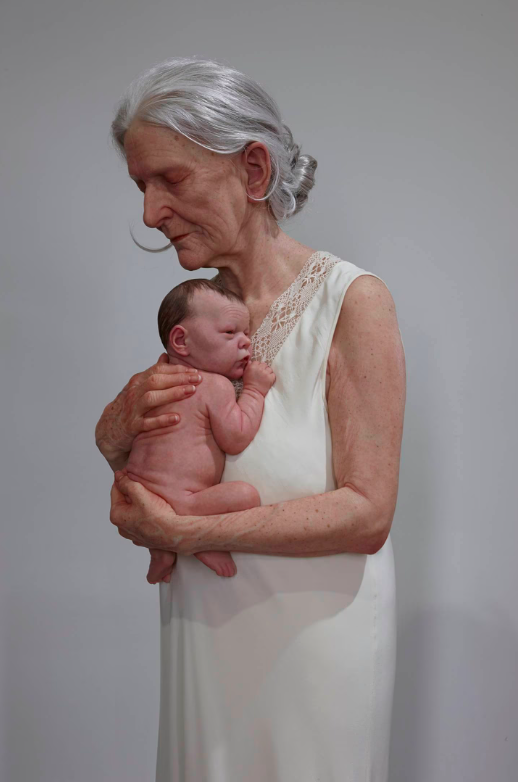
LOOK: Woman and Child, 2010, Sam Jinks - Source
LISTEN: Simeon’s Song, The Porter’s Gate, feat. Tenielle Neda & Paul Zach - Lyrics & Lead Sheets | Spotify | YouTube
I made us a new playlist! Listen here: Ordinary Time, pt. 2: Love My Neighbor and Myself
READ: Jonah 2:1–10; Psalm 29; Romans 9:1–5; Matthew 14:22–33
Readings for the rest of the week*: Psalm 128; Song of Solomon; Ecclesiastes 9:7-10; Matthew 6:25-33; 1 Corinthians 6:12-20
(The weekly readings during Ordinary Time are a thematic survey from the Daily Office Lectionary curated by Bobby Gross in Living the Christian Year. If you’d prefer to keep track with the Daily Office Lectionary from the 1979 BCP, you can find those passages here.)
PRAY: Book of Common Prayer, Collect for the Eleventh Week After Pentecost
Almighty God, give us the increase of faith, hope, and love; and, that we may obtain what you have promised, make us love what you command; through Jesus Christ our Lord, who lives and reigns with you and the Holy Spirit, one God, for ever and ever. Amen.
READ: An excerpt from The Spacious Path, Part 3 (pp. 184-186)
BODIES, HEARTS, AND MINDS
When Jesus told the law expert to love God with all his heart, soul, mind, and strength he wasn’t speaking in riddles; he was inviting a whole person to wholly love God, others, and himself. The entire person is the self we consider as we discern a Rule of Life. We are one being centered in three parts: body (our physical center), mind (our intellectual center), and heart (our emotional center). Made in the image of the triune God, we are one person with distinct parts. Dallas Willard calls the work of spiritual formation the process of “effectively organizing” all these essential parts of ourselves around God. We hold this in common with each other, and, in the language of the greatest commandment, our tender care for each other and ourselves nurtures our mutual love as an offering of worship to God.
Spacious bodies
Of all the spiritual disciplines, hospitality might be the one that helps us practice best what it means to be a human body. Unfortunately, for many of us, our bodies feel more like unwanted guests. Alternatively, we might treat our body not as a guest but as a dissatisfied tyrant. We see these two postures—rejection and oppression—in the way we treat our own bodies and the bodies around us. Hospitality, however, teaches us to receive, nurture, and provide care for our bodies. Paul assumes this perspective in Ephesians 5 when he says, “No one ever hates his own body, but he nourishes and tenderly cares for it” (NRSVue).
I’m not sure who Paul is thinking about when he writes that verse, but from my perspective, plenty of people hate their own bodies. Unfortunately, the historical church and the ever-evolving Christian marketing subculture have too often appropriated the dominant culture’s standard for body size, marketing a faulty theology that suggests God wants your body to look and behave by societal standards. This isn’t a modern phenomenon. As long as humans have had bodies, we’ve been finding ways to mistreat them. Without a healthy theology of the goodness of the body, we don’t walk a spacious path. Every other ideal leads away from the restful way of Jesus.
…
Only the loving gaze of our Creator is sturdy enough to keep us from falling prey to our culture’s shifting ideals. In this light, we can come out of our hiding places and rightly respond with both grateful acceptance and humble conviction to whatever our Creator asks of our bodies. In this response, we participate in the most life-altering kind of acceptance, one that reconciles us with thanksgiving for what God has made, contentment for what God is making, and hope for what God will one day fully restore.
DO: For these middle seven weeks of Ordinary Time, we’ll consider a cycle of God’s love that alternates between permission to love ourselves and the imperative to love our neighbor. This week, consider how the expression of God’s loving hospitality informs how we perceive and care for our own bodies. We care for others as we care for ourselves—our actual living, breathing, and needing bodies. As you commune with God, consider the following questions:
What is your attitude toward your own body with its needs and pleasures?
Do you need to hear God’s permission to care for and enjoy your body?
Do you respond to your own body with indifference or neglect, giving your time, energy, and money toward habits of your mind or emotional needs only? Or have you noticed that your response to your body is anxious and indulgent—overspending time, energy, and money?
*During Ordinary Time this year, I’ll be curating the weekly themes, music, readings, and practices from four sources:
Sunday lectionary readings from Year A of the Book of Common Prayer 2019 (Anglican Church of North America).
Weekly themes and select lectionary readings from the excellent devotional guide, Living the Christian Year: Time to Inhabit the Story of God by Bobby Gross
Weekly song to meditate from the sacred ecumenical arts collective, The Porter’s Gate because it feels like they’ve curated their discography to coordinate with the themes of Ordinary Time in Living the Christian Year!
Weekly readings and suggested practices from my book The Spacious Path: Practicing the Restful Way of Jesus in a Fragmented World because I was definitely influenced by Living the Christian Year! While it’s not necessary to purchase the book to follow along with us, I’d be grateful if you did!