Hospitality That Leads All of Us Home: Week 10 of Ordinary Time
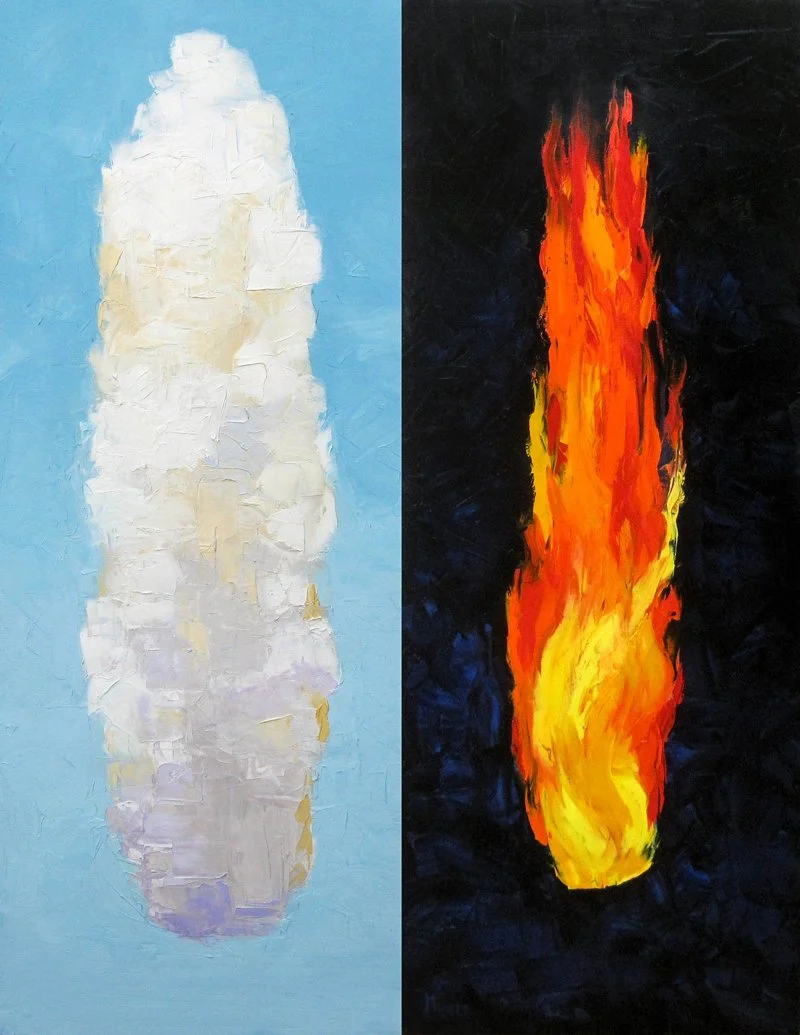
We’re one-third of the way through Ordinary Time! For the next seven weeks, following Bobby Gross’ excellent outline for Ordinary Time, we’ll consider a cycle of God’s love that alternates between permission to love ourselves and the imperative to love our neighbor. Year A of the lectionary roots us in the oldest, grandest story of the Jewish people, liberated from Egypt only to find themselves wandering and hungry in the wilderness, and then enfleshes the history with Jesus miraculously multiplying bread for the hungry, Roman-oppressed crowds wandering from town to town to hear the words of a new Rabbi. The tent pole for this week’s scriptural tent is Paul’s sweeping description of the love of Christ, a love so powerful that nothing can come between us and this love. The love that guides us like a pillar of cloud by blue-sky days and a pillar of fire in the darkest of our nights, nourishes us so deeply we can’t help but share it with all of the wandering, hungry to receive it with us.
LOOK: Guidance Day and Night, Mike Moyers - Source
LISTEN: Nothing to Fear, The Porter’s Gate, feat. Audrey Assad - Lyrics & Lead Sheets | Spotify | YouTube
I made us a new playlist! Listen here: Ordinary Time, pt. 2: Love My Neighbor and Myself
READ: Nehemiah 9:16–21; Psalm 78:14–26v; Romans 8:35–39; Matthew 14:13–21
Readings for the rest of the week*: Genesis 18:1-17; Deuteronomy 10:12-22; Psalm 23; Ruth 2; 4:13-22; Matthew 25:31-46; Luke 14:1-14; 3 John
(The weekly readings during Ordinary Time are a thematic survey from the Daily Office Lectionary curated by Bobby Gross in Living the Christian Year. If you’d prefer to keep track with the Daily Office Lectionary from the 1979 BCP, you can find those passages here.)
PRAY: Book of Common Prayer, Collect for the Tenth Week After Pentecost
Almighty and merciful God, it is only by your grace that your faithful people offer you true and laudable service: Grant that we may run without stumbling to obtain your heavenly promises; through Jesus Christ our Lord, who lives and reigns with you and the Holy Spirit, one God, now and for ever. Amen.
READ: An excerpt from The Spacious Path, Part 4 (pp. 205-206, 207=210)
KEEP COMPANY WITH ME
Hospitality is another one of those Christian words we reference often, yet understand only a little. For years, I assumed hospitality was the habit of having people over to the house and serving them a nice meal. My mother and grandmother excelled in this kind of hospitality, and I eagerly followed all the things they’d taught me. Yet hospitality, like rule, means so much more than this one thing. We hear the dimensions of spacious hospitality in the many English words we use from this one root word, hospitalitas, including hospital, hotel, hospice, and host. I’ve read that the Greek word for hospitality, philoxenia, means love of foreigners or strangers, and that the root word Xenos or hospes can mean three things: stranger, guest, and host. The interchanging roles of hospitality are embedded in the roots of the word. As in the life of Jesus, we see the rhythm of hospitality as moving with each other in the giving and receiving of hospitality.
Hospitality motivates every act of loving presence we give and receive. In terms of a Rule of Life as a spacious path, I’m inviting us to especially imagine hospitality as a commitment to loving the vulnerable. The command to love the “other” saturates the entire Bible, and the terms are not vague. When God tells us to love the “other,” scripture tells us exactly who that means we should love: the stranger, foreigner, prisoner, and outcast….
HOSPITALITAS
Professor and writer Christine Pohl says that the dimensions of our hospitality are shaped by the “wideness of God’s mercy and the generosity of God’s welcome.” The monastic rule for hospitality takes this boundless measure of God’s hospitality seriously, receiving every guest as if they were Christ. From my experience in the Irish monastery, I know that sometimes monks aren’t especially warm in their hospitality. Father Donovan welcomed us, kind of like the monk in the old monastic legend who, seeing in the distance yet another guest entering the monastery grounds, mutters under his breath, “Oh, Christ, is that you again?” In response to God’s abundance, we are continually enlarging our borders and sharing more of our resources; we give with what we’ve been given—everything—to the Christ who comes again and again and again.
It’s no small fact that the development of hospitals in the late fourth century coincided with the monastic movement of the same time. As Christians gathered inward in monastic contemplation, their prayer became an embodied, healing presence to the sick and dying around them.
In his rule, Benedict writes, “All guests to the monastery shall be welcomed as Christ because he will say, ‘I was a stranger, and you took me in.’” Hospitalitas in the Benedictine tradition is a radical hospitality, but no more radical than what Jesus demonstrates in his life. One of my favorite observations about how Jesus demonstrates hospitality is that we see him receive hospitality almost as often as we see him offer hospitality (maybe even more). In this way, our definition of spacious hospitality expands from the perspective of a patron or benefactor to the withness Jesus lives with others. In Jesus’ restful way, hospitality becomes a way to welcome and be welcomed, to give and receive care, to be merciful and receive mercy…
In a stunning act of abundant hospitality, our Jewish neighbors made a home for our homeless Anglican church within the walls of their synagogue. Making room for us in their cherished worship space would be loving on its own, but what they have offered us and what we have reciprocated is a lov- ing, embodied presence. Unexpectedly, we have become each other’s community in demonstrating love to the neighborhood. When one congregation collects supplies to offer Afghan refugees, the other congregation joins in. In the winter, when our congregation wraps a Christmas tree with mittens and scarves collected for the nearby city mission, Congregation Rodeph Sholom adds to the tree with us.
We also participate in each other’s celebrations and suffering. During Sukkot, our children craft paper chains to decorate the booth behind the synagogue, and during Hanukkah, we hold hands and dance in a circle together. On Twelfth Night, they come to our party and sing carols with us. When Brian bakes the round loaves of bread he serves our congregation for eucharist, he adds honey from the jar our Jewish neighbors gave us during Rosh Hashanah. On Yom HaShoah, we all light candles remembering the Jewish people who were murdered at the hands of the Nazis during the Holocaust of World War II.
We go to church on Sundays after our Jewish friends worshiped on Saturday in a building protected by police and security guards. When anti-Semitism rears its evil head, we hope our Jewish neighbors feel buffered by our presence. When our impoverished city’s homeless and hopeless citizens wander into the courtyard from the streets, they do not care if a Jew or a Gentile greets them. They encounter the reality of community as a loving, embodied presence in their neighborhood. A Rule of Life provides a spacious path for giving and receiving love with a community of those we consider culturally or religiously “other” from ourselves.
Together, we receive the spacious hospitality of God, and together, we extend it.
DO: This week, consider how the expression of God’s love flows to us and through us to our neighbors in the form of hospitality. First, God sets a table for us and then instructs us to invite others to the table.
As you commune with God, consider the following questions:
Who do you know who could benefit from the kind of hospitality that reflects the character of God?
What plans could you make this week to show such hospitality to someone in the coming days or weeks?
*During Ordinary Time this year, I’ll be curating the weekly themes, music, readings, and practices from four sources:
Sunday lectionary readings from Year A of the Book of Common Prayer 2019 (Anglican Church of North America).
Weekly themes and select lectionary readings from the excellent devotional guide, Living the Christian Year: Time to Inhabit the Story of God by Bobby Gross
Weekly song to meditate from the sacred ecumenical arts collective, The Porter’s Gate because it feels like they’ve curated their discography to coordinate with the themes of Ordinary Time in Living the Christian Year!
Weekly readings and suggested practices from my book The Spacious Path: Practicing the Restful Way of Jesus in a Fragmented World because I was definitely influenced by Living the Christian Year! While it’s not necessary to purchase the book to follow along with us, I’d be grateful if you did!