They Did Not Believe In His Wonders: Lent Daybook 21
Take a few deep breaths, settle your body, mind, and heart into a quiet space, and let’s begin with prayer.
Opening prayer: Heavenly Father, make me more like Jesus and more like the true self you’ve created as I savor your loving presence today. Please guide my thoughts and impressions by your Holy Spirit. Amen.
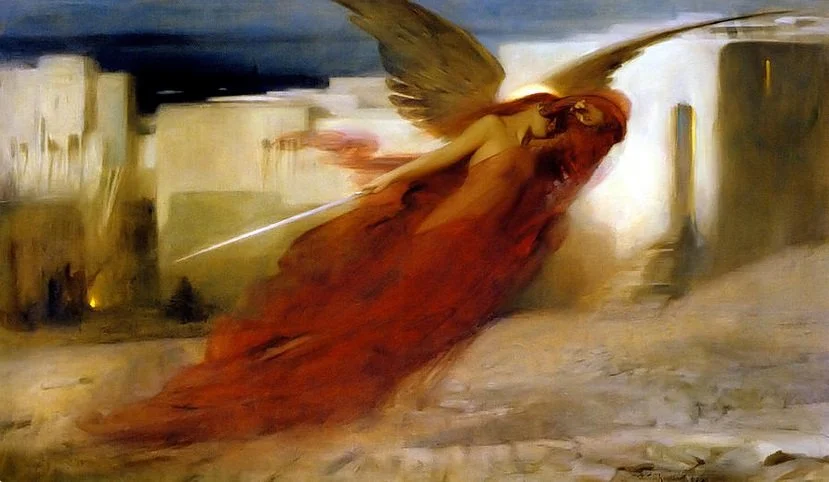
Look: And There Was a Great Cry in Egypt, Arthur Hacker - Source
Listen: Coventry Carol, Balmorhea - Lyrics | Spotify | YouTube
Read: Psalm 78; Jeremiah 7:21-34; Romans 4:13-25; John 7:37-52
Excerpts:
Give ear, O my people, to my teaching; incline your ears to the words of my mouth. I will open my mouth in a parable; I will utter dark sayings from of old, things that we have heard and known, that our ancestors have told us. We will not hide them from their children; we will tell to the coming generation the glorious deeds of the Lord and his might and the wonders that he has done.
He established a decree in Jacob and appointed a law in Israel, which he commanded our ancestors to teach to their children, that the next generation might know them, the children yet unborn, and rise up and tell them to their children, so that they should set their hope in God, and not forget the works of God, but keep his commandments; and that they should not be like their ancestors, a stubborn and rebellious generation, a generation whose heart was not steadfast, whose spirit was not faithful to God.
The Ephraimites, armed with the bow, turned back on the day of battle. They did not keep God’s covenant and refused to walk according to his law. They forgot what he had done and the miracles that he had shown them. In the sight of their ancestors he worked marvels in the land of Egypt, in the fields of Zoan. He divided the sea and let them pass through it and made the waters stand like a heap. In the daytime he led them with a cloud and all night long with a fiery light. He split rocks open in the wilderness and gave them drink abundantly as from the deep. He made streams come out of the rock and caused waters to flow down like rivers.
Yet they sinned still more against him, rebelling against the Most High in the desert. They tested God in their heart by demanding the food they craved. They spoke against God, saying, “Can God spread a table in the wilderness? Even though he struck the rock so that water gushed outand torrents overflowed, can he also give bread or provide meat for his people?”
Therefore, when the Lord heard, he was full of rage; a fire was kindled against Jacob, his anger mounted against Israel, because they had no faith in God and did not trust his saving power. Yet he commanded the skies above and opened the doors of heaven; he rained down on them manna to eat and gave them the grain of heaven. Mortals ate of the bread of angels; he sent them food in abundance. He caused the east wind to blow in the heavens, and by his power he led out the south wind; he rained flesh upon them like dust, winged birds like the sand of the seas; he let them fall within their camp, all around their dwellings. And they ate and were well filled, for he gave them what they craved. But before they had satisfied their craving, while the food was still in their mouths, the anger of God rose against them, and he killed the strongest of them and laid low the flower of Israel.
In spite of all this they still sinned; they did not believe in his wonders. So he made their days vanish like a breath and their years in terror. When he killed them, they searched for him; they repented and sought God earnestly. They remembered that God was their rock, the Most High God their redeemer. But they flattered him with their mouths; they lied to him with their tongues. Their heart was not steadfast toward him; they were not true to his covenant. Yet he, being compassionate, forgave their iniquity and did not destroy them; often he restrained his anger and did not stir up all his wrath. He remembered that they were but flesh, a wind that passes and does not come again.
*
Thus says the Lord of hosts, the God of Israel: Add your burnt offerings to your sacrifices, and eat the flesh. For in the day that I brought your ancestors out of the land of Egypt, I did not speak to them or command them concerning burnt offerings and sacrifices. But this command I gave them, “Obey my voice, and I will be your God, and you shall be my people; walk only in the way that I command you, so that it may be well with you.” Yet they did not obey or incline their ear, but, in the stubbornness of their evil will, they walked in their own counsels and looked backward rather than forward. From the day that your ancestors came out of the land of Egypt until this day, I have persistently sent all my servants the prophets to them, day after day, yet they did not listen to me or pay attention, but they stiffened their necks. They did worse than their ancestors did. …
Therefore the days are surely coming, says the Lord, when it will no more be called Topheth or the valley of the son of Hinnom but the valley of Slaughter, for they will bury in Topheth until there is no more room. The corpses of this people will be food for the birds of the air and for the animals of the earth, and no one will frighten them away. And I will bring to an end the sound of mirth and gladness, the voice of the bride and bridegroom in the cities of Judah and in the streets of Jerusalem, for the land shall become a waste.
*
How often they rebelled against him in the wilderness and grieved him in the desert! They tested God again and again and provoked the Holy One of Israel. They did not keep in mind his power or the day when he redeemed them from the foe, when he displayed his signs in Egypt and his miracles in the fields of Zoan. He turned their rivers to blood, so that they could not drink of their streams. He sent among them swarms of flies that devoured them and frogs that destroyed them. He gave their crops to the caterpillar and the fruit of their labor to the locust. He destroyed their vines with hail and their sycamores with frost. He gave over their cattle to the hail and their flocks to thunderbolts. He let loose on them his fierce anger, wrath, indignation, and distress, a company of destroying angels. He made a path for his anger; he did not spare them from death but gave their lives over to the plague. He struck all the firstborn in Egypt, the first issue of their strength in the tents of Ham. Then he led out his people like sheep and guided them in the wilderness like a flock. He led them in safety so that they were not afraid, but the sea overwhelmed their enemies. And he brought them to his holy hill, to the mountain that his right hand had won. He drove out nations before them; he apportioned them for a possession and settled the tribes of Israel in their tents.
Yet they tested the Most High God and rebelled against him. They did not observe his decrees but turned away and were faithless like their ancestors; they twisted like a treacherous bow. For they provoked him to anger with their high places; they moved him to jealousy with their idols. When God heard, he was full of wrath, and he utterly rejected Israel. He abandoned his dwelling at Shiloh, the tent where he dwelt among mortals, and delivered his power to captivity, his glory to the hand of the foe. He gave his people to the sword and vented his wrath on his heritage. Fire devoured their young men, and their young women had no marriage song. Their priests fell by the sword, and their widows made no lamentation. Then the Lord awoke as from sleep, like a warrior shouting because of wine. He put his adversaries to rout; he put them to everlasting disgrace.
He rejected the tent of Joseph; he did not choose the tribe of Ephraim, but he chose the tribe of Judah, Mount Zion, which he loves. He built his sanctuary like the high heavens, like the earth, which he has founded forever. He chose his servant David and took him from the sheepfolds; from tending the nursing ewes he brought him to be the shepherd of his people Jacob, of Israel, his inheritance. With upright heart he tended them and guided them with skillful hand.
*
For the promise that he would inherit the world did not come to Abraham or to his descendants through the law but through the righteousness of faith. For if it is the adherents of the law who are to be the heirs, faith is null and the promise is void. For the law brings wrath, but where there is no law, neither is there transgression. …
No distrust made him waver concerning the promise of God, but he grew strong in his faith as he gave glory to God, being fully convinced that God was able to do what he had promised. Therefore “it was reckoned to him as righteousness.” Now the words, “it was reckoned to him,” were written not for his sake alone but for ours also. It will be reckoned to us who believe in him who raised Jesus our Lord from the dead, who was handed over for our trespasses and was raised for our justification.
*
On the last day of the festival, the great day, while Jesus was standing there, he cried out, “Let anyone who is thirsty come to me, and let the one who believes in me drink. As the scripture has said, ‘Out of the believer’s heart shall flow rivers of living water.’ ” Now he said this about the Spirit, which believers in him were to receive, for as yet there was no Spirit because Jesus was not yet glorified.
When they heard these words, some in the crowd said, “This is really the prophet.” Others said, “This is the Messiah.” But some asked, “Surely the Messiah does not come from Galilee, does he? Has not the scripture said that the Messiah is descended from David and comes from Bethlehem, the village where David lived?” So there was a division in the crowd because of him. Some of them wanted to arrest him, but no one laid hands on him.
—Psalm 78:1- 39; Jeremiah 7:21-26, 32-34; Psalm 78:40-72; Romans 4:13-15, 20-25; John 7:37-44
Pray: A Body Prayer from Julian of Norwich (adapted from this source)
Read the brief introduction and then, knowing that you are held body, mind, and emotions in the presence of the Father, Son, and Holy Spirit hold each pose of the prayer for 1-2 minutes. You can pray this prayer from your bed, your exercise mat, or wherever you find yourself today.
“An interesting example of Christian body prayer comes from Julian of Norwich, who lived during the time of the plague in England in the 14th c. Julian experienced severe bodily pain when she was thirty years old, during which she received visions, which she later recorded in Revelations of Divine Love. Julian wrote, "The fruit and the purpose of prayer is to be "oned" with God in all things."
Julian's Body Prayer is comprised of four poses and intentions: Await, Allow, Accept, and Attend.
The first pose, Await, is a posture of receiving, held with cupped hands extended at the waist to receive the presence of God.
The second pose, Allow, is a posture of opening, reaching up with the hands open to the coming of God's presence.
The third pose, Accept, takes in whatever comes, standing with hands cupped at the heart, head bowed.
The final posture, Attend, is assumed with hands extended and palms open in willingness to act on what has been given.
Once you have completed each pose, consider signing the cross over your head and heart in the name of the Father, Son, and Holy Spirit and go back into your day with peace.
Do: This week, ask the Holy Spirit to make you aware of the times throughout the day that you operate out of preconceived ideas (judgments) about God, others, and yourself. Make the time at least once a day to stop what you’re doing and practice a hospitable imagination in one of the following ways:
Make space for divergent opinions
Make space for meaning
Make space for listening
Make space for conversation
Make space for reading outside your tradition
Make space for curiosity
Make space for pausing
Sometime this week, share with us one way you’ve practiced a hospitable imagination and what the experience was like for you. You can leave a comment on the blog, Facebook, Instagram, or reply directly to this email.
*Sunday Scripture readings are taken from Year A of the Book of Common Prayer 2019 (Anglican Church of North America). Daily Scripture readings are taken from the 1979 Book of Common Prayer and include both Morning and Evening Psalms (Year 1).