The Praying and Sharing Community: Week 3 of Ordinary Time
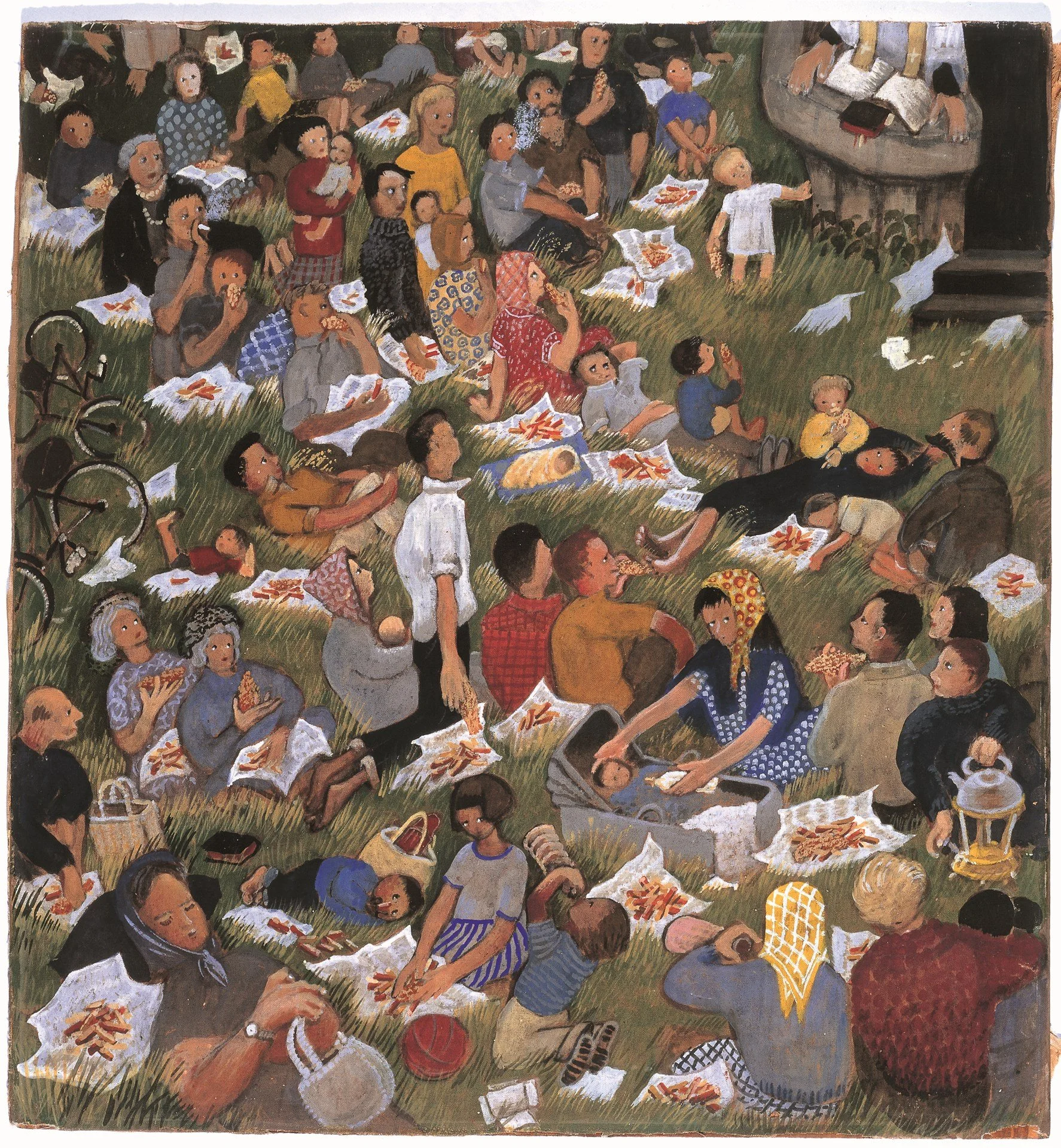
We’re in the season of Ordinary Time - the long stretch of weeks between Pentecost and Advent. If the historic liturgical calendar teaches us to number our days to gain a heart of wisdom, there must be a lot of wisdom to be gained in our regular, working, resting, and worshipping lives. This is the model Christ seemed to have lived, and the church invites us to embrace the same pathway.
LOOK: The Five Thousand, Eularia Clarke - Source
LISTEN: Open Hands, The Porter’s Gate, feat. Paul Zach, Taylor Leonhardt & Jessica Fox - Lyrics | Spotify | YouTube
Here’s a playlist I made for us a few years ago! Ordinary Time, pt. 1: Worshipin the World and Church
READ: Psalm 2; Luke 11:1-13; Luke 12:13-34; Acts 2:42-47; Acts 4:23-5:11; Philippians 4:4-20
Readings for the rest of the week: Psalm 2; Luke 11:1-13; Acts 2:42-47; Acts 4:23-5:11; Philippians 4:4-20
(The weekly readings during Ordinary Time come from Living the Christian Year by Bobby Gross. If you’d prefer to keep tracking with the Daily Office Lectionary from the 1979 BCP, you can find those references here.)
PRAY: Book of Common Prayer, Collect for the Third Week After Pentecost
O Lord, from whom all good proceeds: Grant us the inspiration of your Holy Spirit, that we may always think those things that are good, and by your merciful guidance may accomplish the same; through Jesus Christ our Lord, who lives and reigns with you and the Holy Spirit, one God, for ever and ever. Amen.
PRAY: A Prayer for Receiving and Letting Go
READ: FAMILIES, FRIENDS, AND NEIGHBORS, AND THOSE WHO ARE ALONE
An excerpt from The Spacious Path, chapter 11, “Ordinary Days” (pp. 178-180)
“As part of our worship liturgy following the sermon each Sunday, we pray for the church, world, and our community in a particular way, known as the Prayers of the People. In one part of the prayer, the person leading says, “In peace, we pray to you, Lord God. For all people in their daily life and work,” and together as a congregation, we respond, “For our families, friends, and neighbors, and for those who are alone.” There are a few variations for this liturgy, but this version is my favorite. I love the cadence and comprehensiveness of this little litany that holds together the relationships that make up our daily lives and provide the “local ground” of our life story.
The relationships of family, friends, and neighbors populate almost every part of a spacious Rule of Life. I could write an entire book for just this section because these relationships— the people with whom we share the most ordinary and extraordinary seasons of our lives—are inextricably intertwined with our understanding of our true selves and of the shape of our work in the world. For now, I’d like to share one learning from my own life for each of these four groups of people who have seen the best and worst versions of me and who have helped me to form a more spacious understanding of the nature of love in the reality of my daily life.
Spacious family
I know, I know—if you’re a parent, old ladies have stopped you in the store to warn you that the time flies by faster than you can imagine and that you need to make the most of every single moment with your cherubs. I’ve discovered that that’s sort of true. Most true, though, is that Jesus is a redeemer of time. It’s taken a couple of decades, but I can see how God has been answering the prayer that our family’s way of being reflects, most importantly, the God who loves us tenderly. I am now a grandmother who sits nearby and tries to offer a restful presence. I watch my daughter Kendra and son-in-law Jordan care for our first grandson with a kind of ease we barely understood as new parents decades ago. I watch in awe and notice God has arrived in their peaceful, patient attention to Julian. I have not missed it. God moves outside of time and space, God returns time and stretches it out in just the right ways so he can save us all.
As I become the old lady stopping young parents in the grocery store, I’m trying to say instead: Don’t worry. You’ve got time, and it’s going to take time.
In those years I described earlier where I forced routines on my family that were ill-fitting and burdensome for them (and for me), I was living in false narrative where the terms mother and pretensions of holiness were synonymous. I thought I was supposed to be straitlaced and spit-spot. I thought my role in the family was to nurture an enclosed breeding ground for spiritual perfection, which resulted in forced routines and anxious attention toward my children and husband. What I have learned—so often the hard way, and so often because of the gracious forgiveness of my husband and children—is that a family is not a place of enclosure but instead an outpost of welcome and a nurturing place to live a loving, embodied presence in the literal world around us. Spacious families are formed with the same practices that help us discern the spacious path of a Rule of Life—through ordinary practices of humble, prayerful listening and loving, embodied presence. Understanding that my nuclear family is not the center point around which God’s kingdom orbits invites me to envision walking through each season of my life in much the same way I might circle a prayer labyrinth—often feeling like I’m walking in circles and never getting anywhere, yet held by a spacious path directing me in the way of Jesus and others—including, and in precious, particular ways, my husband and children.
More than ever—as the world continues to experience relational and geographic fragmentation—we need to expand our understanding of family. When Jesus called his disciples, he always called them to leave everything behind including their families. We know this did not mean ignoring God’s commandments to honor their fathers and mothers and care for their children and spouses. Instead, we hear Jesus’ invitation to step into the larger family of God, the spacious family that includes every tribe, people, and nation, especially those who are alone. I am amazed by the stories I witness in my community as friends expand their households in creative, life-giving, sometimes even life-saving, ways. God’s household is a spacious place for the most vulnerable; Jesus invites families that become households for the least of these (Matthew 25) into unforced rhythms of rest with him.”
DO: For the first eight weeks of Ordinary Time, we’ll consider how we embody God’s love in the world and the church. This week, reconnect with a praying and sharing community.
Have the last few years interrupted your regular rhythms of gathering with your church community?
Are you part of a small group of fellow Christians that meets regularly to share in each other’s lives, to learn together, to seek God in prayer, and to support one another in tangible ways? If not, could this be the time to find or form such a praying and sharing community?
During Ordinary Time this year, I’ll be curating the weekly themes, music, readings, and practices from four sources:
Sunday lectionary readings from Year A of the Book of Common Prayer 2019 (Anglican Church of North America).
Weekly themes and select lectionary readings from the excellent devotional guide, Living the Christain Year: Time to Inhabit the Story of God by Bobby Gross
Weekly song to meditate from the sacred ecumenical arts collective, The Porter’s Gate because it feels like they’ve curated their discography to coordinate with the themes of Ordinary Time in Living the Christian Year!
Weekly readings and suggested practices from my book The Spacious Path: Practicing the Restful Way of Jesus in a Fragmented World because I was definitely influenced by Living the Christian Year! While it’s not necessary to purchase the book to follow along with us, I’d be grateful if you did!