Thrice Holy: Trinity Sunday
Blessed Trinity Sunday, friends! Today marks the final Sunday before Ordinary Time (also known as "Proper Sundays", also known as "Sundays After Pentecost", also known as "Sundays After Trinity Sunday"!)
If I were in charge, I'd call the coming weeks of the calendar the Trinity Season. The Trinity exists more than as an essential part of Christian doctrine (which it assuredly is), but as the living, loving ultimate reality in which we live, move, and have our being.
We are welcomed into the never-depleted communion of Father, Son, and Spirit and find our truest selves in their midst. We move outward, extending this hand of fellowship to the world, not as individuals, but as those who've been deeply and thoroughly welcomed into the friendship of God. When we love the world, we are embodying this pulsing reality of the Triune God.
So, celebrate today well, friends. We are deeply welcomed, loved, and abundantly refreshed to share the love indiscriminately with the world.
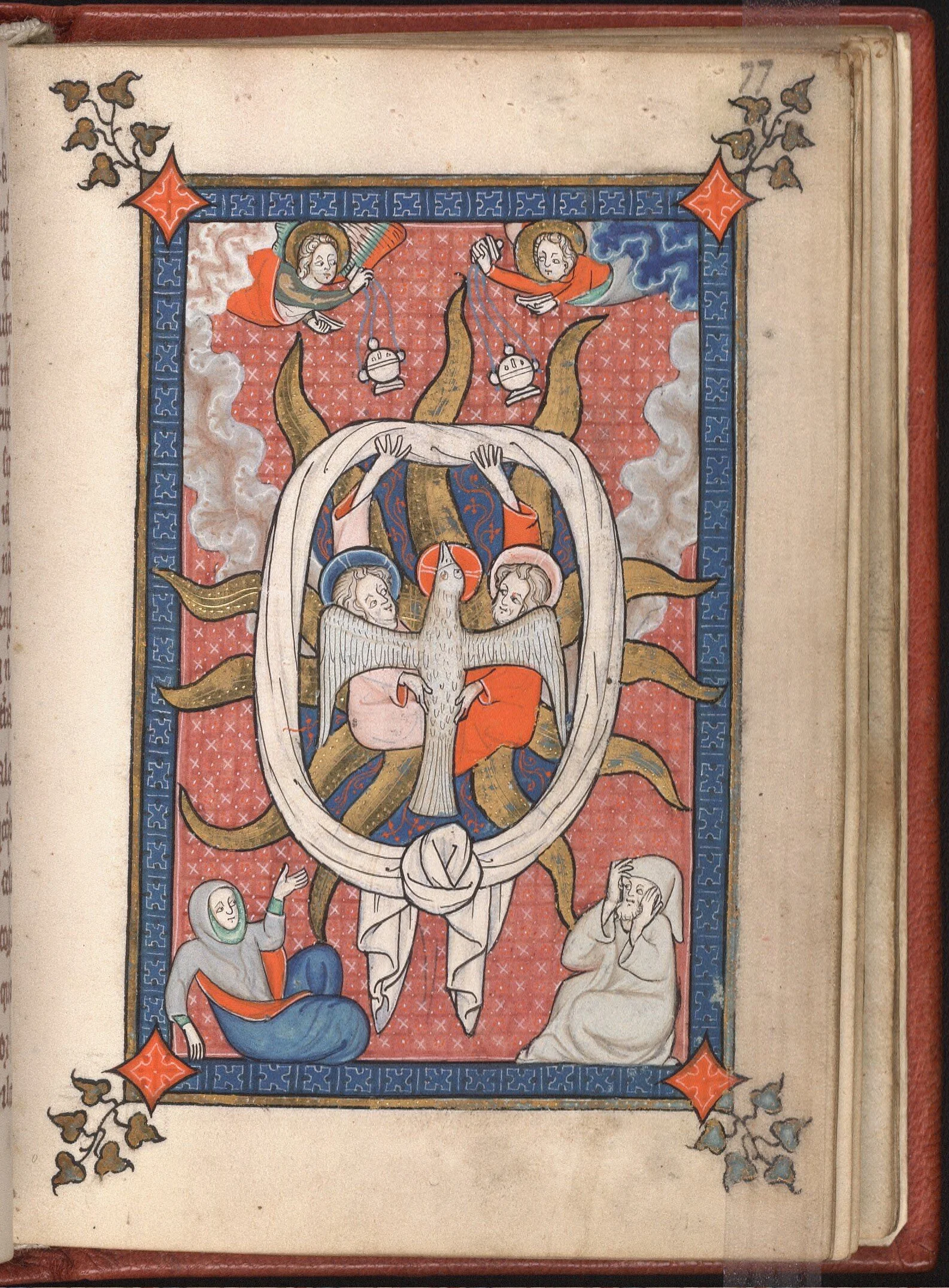
LOOK: “Pater complacet sibi in Filio et Filius in Patre, et Spiritus sanctus ab utroque” (The Father is well pleased in the Son, and the Son in the Father, and the Holy Spirit is from both), from Rothschild Canticles - Source
Commentary from Victoria Emily Jones [Art & Theology]: The Rothschild Canticles is the name of a lavishly illuminated manuscript of Franco-Flemish origin, produced at the turn of the fourteenth century. “A potpourri of biblical verses, liturgical praise, dogmatic formulas, exegesis, and theological aphorisms, . . . the manuscript leads its user step by step through meditations on paradise, the Song of Songs, and the Virgin Mary to mystical union and, finally, contemplation of the Trinity,” describes Barbara Newman in her excellent essay “Contemplating the Trinity: Text, Image, and the Origins of the Rothschild Canticles.”
The manuscript lacks any provenance before 1856, but Newman proposes that it was made at the Benedictine abbey of Bergues-Saint-Winnoc in Flanders, located at what is today the northern tip of France. The compiler of its texts, she suggests, was probably the same person who designed its remarkable images—most likely a monk of Saint-Winnoc, who probably employed a professional lay artist from Saint-Omer to execute the designs. The book’s patron was probably a canoness at the nearby abbey of Saint-Victor. It is now preserved at the Beinecke Rare Book and Manuscript Library at Yale University in New Haven, Connecticut. All photographs in this post are courtesy of the Beinecke. Click here to page through the fully digitized manuscript.
The most extraordinary section of the book is a florilegium (collection of literary extracts) on the Trinity, which comprises folios 39v–44r and 74v–106r and draws especially on Augustine’s De Trinitate. Within these pages are nineteen full-page miniatures that exhibit “the most stunning iconographic creativity, . . . bearing witness to a distinctive Trinitarian theology.” [READ MORE]
LISTEN: Trisagion, Choir of the Monks of Chevetogne - Spotify | YouTube
Text: The Trisagion (in Greek, “thrice holy”) prayer is an ancient prayer in Christianity.
In English, the literal translation is: Holy God, Holy Strong, Holy Immortal, have mercy on us.
In English, the common liturgical translation is: Holy God, Holy Mighty, Holy Immortal, have mercy on us.
READ: Genesis 1:1—2:3; Psalm 150; 2 Corinthians 13:5-14; Matthew 28:16-20
Daily readings for the week of Trinity Sunday
Monday (6/5) Psalm 41, 52; Psalm 44; Deuteronomy 11:13-19; 2 Corinthians 5:11-6:2; Luke 17:1-10
Tuesday (6/6) Psalm 45; Psalm 47, 48; Deuteronomy 12:1-12; 2 Corinthians 6:3-7:1; Luke 17:11-19
Wednesday (6/7) Psalm 119:49-72; Psalm 49; Deuteronomy 13:1-11; 2 Corinthians 7:2-16; Luke 17:20-37
Thursday (6/8) Psalm 50; Psalm 8, 84; Deuteronomy 16:18-20, 17:14-20; 2 Corinthians 8:1-16; Luke 18:1-8
Friday (6/9) Psalm 40, 54; Psalm 51; Deuteronomy 26:1-11; 2 Corinthians 8:16-24; Luke 18:9-14
Saturday (6/10) Psalm 55; Psalm 138, 139:1-23; Deuteronomy 29:2-15; 2 Corinthians 9:1-15; Luke 18:15-30
PRAY: Collect for Trinity Sunday
Almighty and everlasting God, you have given to us your servants grace, by the confession of a true faith, to acknowledge the glory of the eternal Trinity, and in the power of your divine Majesty to worship the Unity: Keep us steadfast in this faith and worship, and bring us at last to see you in your one and eternal glory, O Father; who with the Son and the Holy Spirit live and reign, one God, for ever and ever. Amen.
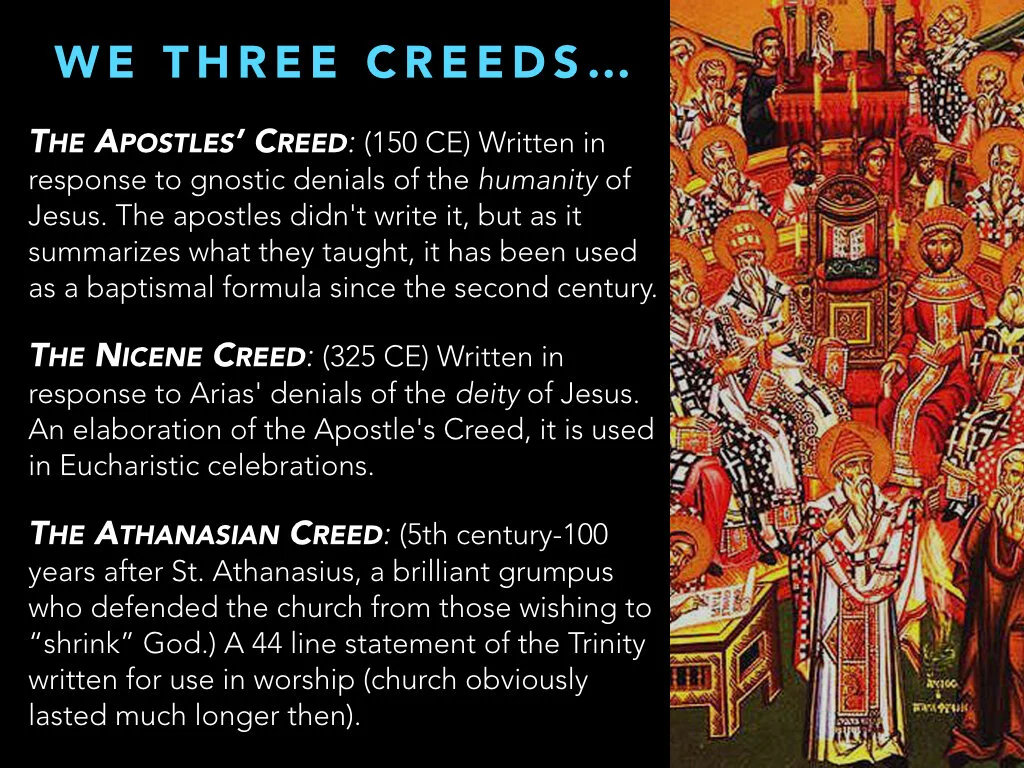
DO: Read the Athanasian Creed out loud today.
The Church adheres to the Athanasian Creed, but boy-howdy we hardly ever say it out loud together! For efficiency and overall crowd appeal, the Apostles Creed seems to be our go-to or the Nicene Creed when we're feeling particularly earnest in worship. But you can't beat the Athanasian Creed for a robust declaration of our gratitude for the Triune God. That's why a lot of churches will pull this one on Trinity Sunday. I encourage you to read it aloud with whomever you're able to find to join you today.
(*Note: if you're unfamiliar with the language of the historic creeds, the word "catholic" means the universal Christian church, not the Roman Catholic (capital “C”) church.)
You might also appreciate:
For more background on this day, visit our friends at The Homely Hours: Trinity Sunday: A Few Traditions and Links.
Trinity Sunday: A Collect Reflection via Anglican Compass
What They Are Saying About the Trinity via Anglican Compass
Sunday Scripture readings are taken from Year A of the Book of Common Prayer 2019 (Anglican Church of North America). Daily Scripture readings are taken from the 1979 Book of Common Prayer and include both Morning and Evening Psalms (Year 1)