For it is the God who said, “Light will shine out of darkness,” who has shone in our hearts: Pentecost Friday
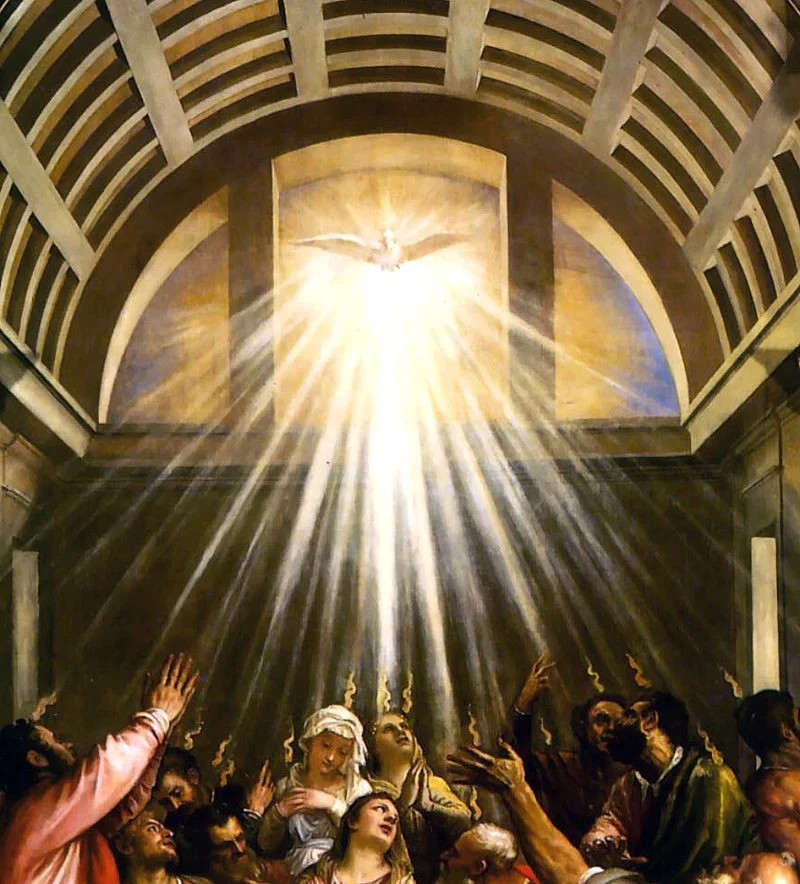
LOOK: Pentecost, Titian - Source
READ: Psalm 31; Psalm 35; Deuteronomy 5:1-22; 2 Corinthians 4:1-12; Luke 16:10-18
PRAY: Prayer to the Holy Spirit
Come, Holy Spirit,
fill the hearts of your faithful,
and enkindle in us the fire of your love.
Send forth your Spirit and we shall be created,
and you shall renew the face of the earth.
Amen.
DO: Throughout the first week of Pentecost, I'll be sharing excerpts from my upcoming book, The Spacious Path: Practicing the Restful Way of Jesus in a Fragmented World. In Part 2 of the book, I invite us to consider Jesus invitation in Matthew 11:28-30 to “walk with him” as an invitation to walk with his church. Today, I’m sharing an excerpt from Chapter 6, “One Center: A Rule for Holding Together the Unity in Diversity of God’s Beloved Community.”
Living in the presence of the Trinity
For a Rule of Life to be a spiritual practice it must connect us with something larger than ourselves, and since it is a Christian practice, we find that connection centered in the beloved community of God. For centuries, the circular shape of a labyrinth—one large circle making up many smaller circuits that lead to one inner center—has spoken to people of all different faiths, because most faith traditions imagine life as a spiritual journey that leads to union with a transcendent being, or god. I prefer to think that the reason for the affinity is because the image and nature of the triune God is stamped on all of us—one God, three persons calling us into a loving communion of one body with many parts. It seems we’re always trying to find the most helpful symbol or metaphor to describe the Trinity.
My whole life, I’ve been taught the image of God as three- in-one, one-in-three. As a child, I learned the doctrine of the Trinity in terms of a metaphor: one egg with three parts: white, shell, and yolk; water as ice, liquid, and steam; an apple as skin, flesh, and seed. I’m grateful for that teaching, but it wasn’t until midway into my thirties, when I was leading a worship ministry in a large church, that I began to ask questions. Questions like, “So what?” and “What difference does it make?”
As it turns out, a robust theology of the Trinity makes a world of difference in the way we worship on Sundays and in the way we live our everyday lives. In the three-personed God, we are invited, commended even, into a mystery. In this beautiful mystery is a beautiful community. The psalmist tells us that God puts the lonely into families. God, who lives and moves and has transcendent being as one-in-community, should know, God lives in the family of Father, Son, and Holy Spirit. This matters more than we imagine. If God, the Creator, identifies as a triune community, how can we—the created ones—identify ourselves as sole individuals?
All those years ago, when our family first moved to Austin, our kids began attending their new schools within a few weeks of our arrival. They didn’t know anyone, and not only that, but they had left a school of hundreds to attend a school of thousands. I’m still amazed by their courage and still grieving what that courage cost them. All I knew to do to help them on some mornings as they packed their books and ate their breakfast cereal was to just keep saying to them, “You are not alone.”
I told them this because I wanted to remind them that every day they are walking with an invisible company, a fellowship. I also told them this because I wanted them to be prepared to hit the intense emotion of the day, the moments they needed to decide to hide or to connect. I wanted them to imagine the presence of this community standing with them in that very moment. I wanted this talk of community to settle down deeply into their imaginations, into their souls in the very tan- gible, daily moments. I wanted them to grab onto the commu- nion of the saints like a zipline plunging into the moment and swinging back up the other side, wind-blown and flip-flopped, maybe, but full of fresh energy, joy, humor, and strength.
In our first month, I wrote them a prayer and offered it as a blessing which I’m not sure they heard me say as they were stepping out the door into the unknown each morning, but maybe I was the one who needed to hear it even more:
Go with Jesus; he is with you. Also, the Father and the Spirit. And all the people praying for you from our new church and our old church, and all our family and friends. Even the angels and the saints in heaven are with you. You are not alone.
The beauty of this spiritual reality shapes everything we are and everything we do. We are beautifully distinct as persons, yet mysteriously, and gloriously, our designed particularity never finds its identity apart from the created Whole. This paradox transforms everything. We submit every part of our lives—individually and corporately—to the three-in-one God: how we gather, how we pray, how we sing, how we make, how we intercede, how we eat, how we work and play together and alone. Knowing we are one part of a whole, created in the image of a triune God, shapes how we hear music, read books, return emails, browse social media, shop at the market, and weed our gardens. We carry with us an awareness of the entire community of God. All that we are and all that we do bears witness to the communal nature of our three-personed God who gathers us from our independent, self-referential postures into an interdependent, beloved community.
Surprisingly, many Christians not only forget the truth of our interconnectedness outside the church but carry the false narrative of a personalized relationship with Jesus into the church as well. In this false narrative, a sanctuary is just a bigger room for a privatized worship experience. Instead, in worship liturgies that remind us that we carry the image of the triune God, forming us week in and week out—one prayer, one sermon, one morsel of bread, and one sip of wine after another—we are welcomed into the full dimensions of God’s beloved community. When we leave the sanctuary, we embody this loving communion, making God visible to each other and the world.
—from Chapter 7, “Centering in the Beloved” pp. 112-114
Sign up for reader's guides and bonus content for The Spacious Path!
In what ways are you aware of the presence of the Trinity in your everyday life? In your waking up, going to sleep, walking around, everyday work, rest, and worship lives?
Read, reflect, journal, and share your own responses with the rest of us in the comment section below.